
In paramedic training, doing always beats reading. You can memorise the steps of an airway insertion or a tourniquet application, but the skill only becomes reliable once you have repeated it with real equipment until the movement is automatic.
That is the whole point of a good student kit: when the tools look and feel like the ones used on the job, students build the muscle memory that holds up under the stress of a real call.
This is why a well-built kit matters so much for any program. It gives students a consistent set of gear to train with in the classroom, the skills lab and the field, and it lets them practise the same task safely, over and over, until they get it right.
Whether you are an instructor equipping a whole cohort or a student assembling your own gear, the 15 items below are the ones that belong in every paramedic student ki and why each one earns its place.
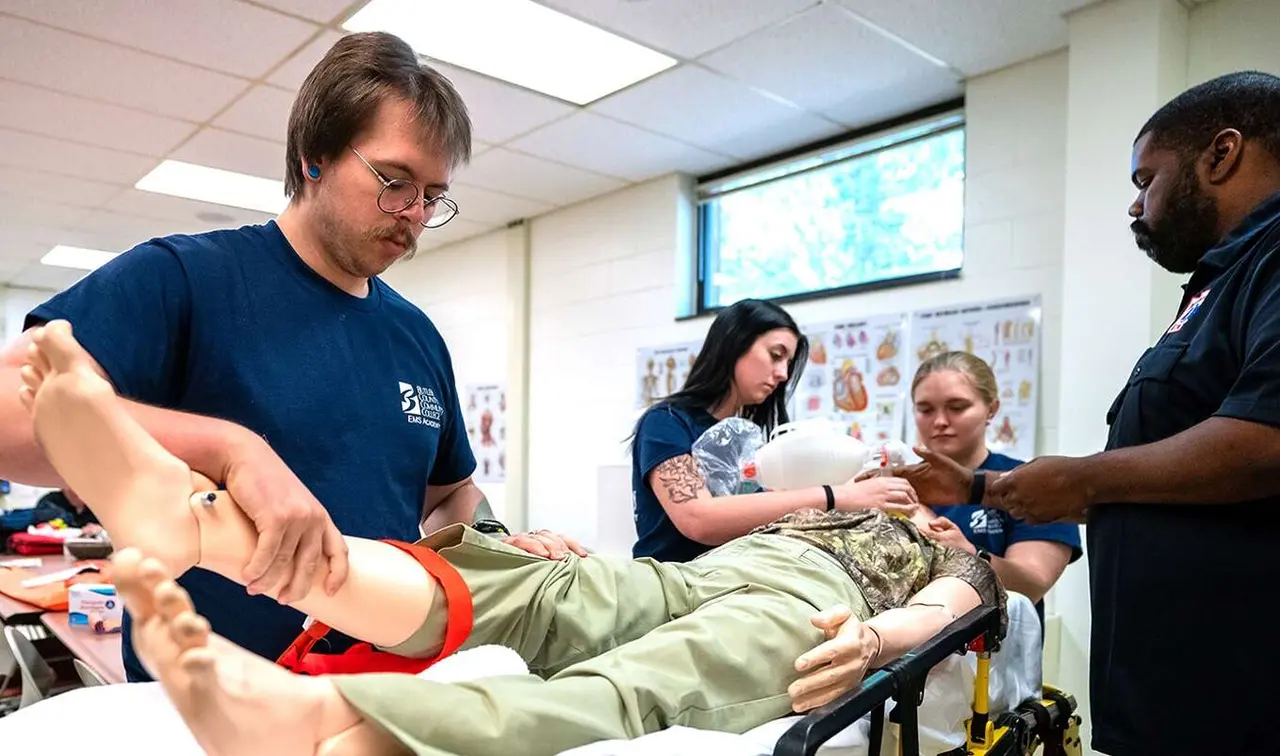
Butler Eagle. (2024, August 22). Benjamin Shumway applies a tourniquet on a manikin during BC3’s inaugural EMS Academy.
1. Stethoscope
An affordable stethoscope is the cornerstone of patient assessment. Students use it to listen to heart, lung and bowel sounds and to take manual blood pressures, so it gets handled on almost every scenario.
Learning to tell normal sounds from abnormal ones early makes every later skill easier, which is why it is worth starting on a dependable model rather than the cheapest one on the shelf.
2. Blood Pressure Cuff
A aneroid sphygmomanometer teaches students to take vitals the right way by feel and by ear, not just off a digital readout. Practising the manual technique builds the judgement to recognise when a patient's numbers are heading the wrong way. It also trains students to track a patient's trend over time, which is often more telling than any single reading.
3. Penlight
A medical penlight is small but does heavy lifting in an assessment. It is used to check pupil size and reactivity, one of the fastest ways to flag a head injury or neurological change. A quick, confident pupil check can surface a serious problem in seconds, so students should be comfortable performing it without fumbling for the light.
4. Trauma Shears
Tough, blunt-tip trauma shears are non-negotiable in a trauma kit. They cut quickly and safely through clothing, seatbelts, bandages and tape so providers can expose an injury fast. The rounded tips matter just as much as the blade they let you work close to the skin without nicking the patient while you race to reach the wound.
5. Tourniquet
Students should train with real, field-grade tourniquets such as the CAT or SOFT-T, not improvised bands. These devices stop heavy, life-threatening bleeding, and applying one correctly and quickly is a core trauma skill. Because seconds count with a major haemorrhage, the only way to build the right speed and technique is to practise on the actual device.
6. IV Start Kit
A practice IV start kit brings together the needles, tape, prep pads, gauze and tourniquet a student needs to rehearse the full sequence. Working through the whole process prep, stick, secure in one flow is what makes the steps stick. Having every piece in one place also teaches students to stay organised under pressure.
7. IV Arm or Practice Vein Pad
A training arm or vein pad is where IV confidence is actually built. Students use it to practise finding veins, threading the catheter and securing the line without any risk to a real patient. It is repetition on a realistic pad that turns a shaky first attempt into a reliable first-stick success.
8. Airway Adjuncts (OPA/NPA)
Oral and nasal airways teach students how to keep an airway open and support a patient's breathing. Sizing each one correctly and inserting it smoothly is a fundamental skill, and the feel of a proper placement only comes with hands-on reps. Mastering basic airway management early gives students a foundation for the more advanced techniques that follow.
9. Bag Valve Mask (BVM)
A working BVM teaches students to deliver controlled ventilations, usually on a manikin, with the correct seal, rate and volume. Effective bag-mask ventilation is one of the most important and most commonly fumbled skills in emergency care. Getting the seal and squeeze smooth takes practice, which is exactly why it belongs in a student's hands early.
10. Pocket Mask or CPR Mask
A reusable CPR mask lets students practise rescue breathing and CPR with a hygienic barrier between rescuer and patient. It is a staple of skills check-offs and scenario work, where students need to perform ventilations safely and repeatedly. Training with the real mask builds the habit of protecting both themselves and the patient.
11. Medication Vials (Simulated)
Practice vials and ampoules let students learn the routine of preparing medications and drawing up the correct dose. Rehearsing this on simulated meds builds accuracy and safe handling habits long before any real drug is involved. It also takes the nerves out of the process, so students move confidently when it counts.
12. Syringes & Needles (Training Only)
Clearly marked, training-only syringes and needles are used to rehearse injections and medication delivery. Repetition here cements both the correct technique and the sharps-safety habits that protect providers on every call. Because they are labelled for school use only, students can practise freely without any clinical risk.
13. Burn Sheets & Trauma Dressings
Burn sheets and trauma dressings are ideal for practising how to manage large wounds and control bleeding. Students learn the right amount of pressure and the proper wrapping technique to keep blood loss in check during drills. Good dressing technique also keeps a wound clean, reducing the chance of contamination on the way to definitive care..
14. Chest Seal (Training Model)
A training chest seal teaches students to manage open chest wounds, a critical and high-stakes trauma skill. A correctly applied seal keeps air from entering the chest cavity, which helps prevent a lung from collapsing. Practising placement on a model means students know exactly what to do when they meet the real injury.
15. Splinting Materials
SAM splints, triangular bandages and roll gauze give students hands-on practice stabilising fractures. Immobilising a limb quickly reduces the patient's pain and, just as importantly, helps prevent further nerve or vascular damage during transport. Learning to splint fast and securely is a skill that pays off on almost every orthopaedic call.
Why These Tools Matter in Paramedic Training
The right tools do far more than fill a checklist they build the confidence and competence that separate a hesitant student from a capable provider. Training with realistic gear sharpens skills and takes the edge off the stress of moving from the classroom into real field work.
There is a practical benefit for programs too: when every student trains with the same equipment, instructors can teach and assess consistently across the entire class.
Build Your Paramedic Student Kit
A complete kit is the starting point for a future life-saver. Whether you are a program director equipping a cohort or a student getting ready for clinicals, the right gear builds a strong foundation for everything that comes next.
When students train with realistic tools, they are ready to act when seconds count. Need help putting one together? Explore our custom clinical kits for EMT & paramedic students.
Do you need help building your custom kits?
We can help. Visit medtechkits.com or call 844-800-8740. Talk with our team about making low-cost, custom kits for your class today.


